In pharmaceutical and biopharmaceutical manufacturing, validation is a critical component of Good Manufacturing Practice (GMP). It provides documented evidence that equipment, systems, processes, and facilities consistently perform as intended and produce products that meet predefined quality specifications.
For manufacturers across Africa, validation is often one of the most technically demanding aspects of GMP compliance. However, when implemented correctly, validation becomes far more than a regulatory requirement—it becomes a powerful tool for process control, risk reduction, and operational efficiency.
Ultra Dynamic Quality Systems (UDQS) supports pharmaceutical manufacturers across the continent in designing and implementing robust validation programs aligned with WHO TRS guidelines, EU GMP Annex 15, and PIC/S standards.
Understanding the Validation Lifecycle
Validation is not a single event but a structured lifecycle that begins during system design and continues throughout operational use.
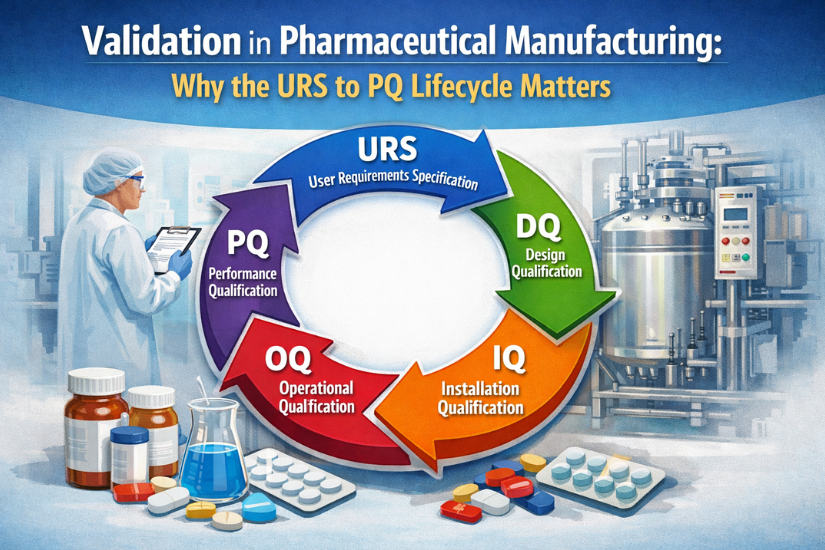
The modern validation framework follows a risk-based lifecycle approach, typically structured as:
URS → DQ → IQ → OQ → PQ
This lifecycle ensures that systems are designed correctly, installed properly, operate as expected, and consistently perform under real production conditions.
1. User Requirement Specification (URS)
The validation lifecycle begins with the User Requirement Specification (URS).
The URS defines what the system or equipment must achieve from an operational perspective. It establishes the foundation for design, procurement, and qualification.
A well-developed URS typically includes:
- Functional requirements
- Performance expectations
- Regulatory compliance requirements
- Safety considerations
- Data integrity requirements
- Environmental and operational conditions
Many validation challenges arise because organizations skip or inadequately develop the URS stage, leading to systems that do not fully meet operational needs.
2. Design Qualification (DQ)
Design Qualification ensures that the proposed design of equipment or systems meets the requirements defined in the URS.
During this phase, engineering specifications, vendor documentation, and design drawings are reviewed to confirm that the system will operate according to GMP requirements.
Key aspects assessed during DQ include:
- Equipment design specifications
- Materials of construction
- Utility requirements
- Control system architecture
- Compliance with regulatory standards
Effective design qualification prevents costly modifications after installation.
3. Installation Qualification (IQ)
Installation Qualification verifies that equipment or systems have been installed correctly according to approved specifications and manufacturer recommendations.
Typical IQ activities include:
- Equipment verification against design drawings
- Utility connections verification
- Calibration status checks
- Instrumentation installation review
- Documentation of installed components
- Verification of safety systems
This stage ensures that the physical installation matches the intended design.
4. Operational Qualification (OQ)
Operational Qualification demonstrates that equipment or systems operate correctly across the defined operating ranges.
Testing performed during OQ typically includes:
- Functional testing of equipment components
- Control system testing
- Alarm verification
- Interlock testing
- Operational range testing
- System response evaluation
The objective is to confirm that the system performs reliably under controlled test conditions.
5. Performance Qualification (PQ)
Performance Qualification confirms that equipment or systems consistently perform as intended under actual operating conditions.
During PQ, the equipment is tested during real production scenarios or simulated manufacturing conditions.
Typical PQ elements include:
- Process consistency verification
- Product quality confirmation
- Process parameter monitoring
- Reproducibility testing
This stage provides final assurance that the system is capable of delivering consistent and reliable performance during routine operations.
Beyond PQ: Modern Process Verification
Modern pharmaceutical quality frameworks extend validation beyond initial qualification.
Regulatory authorities now emphasize Process Performance Qualification (PPQ) and Continuous Process Verification (CPV) to ensure long-term process stability.
These approaches include:
- Statistical process monitoring
- Trending of critical process parameters
- Continuous data analysis
- Lifecycle process improvement
This ensures validation is not a one-time exercise but an ongoing quality assurance process.
Common Validation Challenges in Emerging Pharmaceutical Markets
Many pharmaceutical manufacturers face challenges when implementing validation programs. Common issues include:
- Incomplete URS documentation
- Limited validation expertise
- Poor documentation practices
- Inadequate risk assessments
- Lack of lifecycle validation planning
These challenges can lead to regulatory observations, operational inefficiencies, and delayed product approvals.
The UDQS Approach to Validation
Ultra Dynamic Quality Systems (UDQS) supports manufacturers by implementing structured, compliant validation programs.
Key services include:
- Validation Master Plan (VMP) development
- Equipment qualification (IQ, OQ, PQ)
- Process validation
- Cleaning validation
- Computer system validation
- Risk-based validation strategies aligned with ICH Q9
By combining engineering expertise with regulatory knowledge, UDQS helps organizations establish validation systems that are both compliant and operationally efficient.
Validation as a Foundation for Pharmaceutical Quality
Validation is one of the most important pillars of pharmaceutical manufacturing. When implemented correctly, it provides assurance that systems, processes, and equipment consistently deliver safe and effective products.
For pharmaceutical manufacturers across Africa seeking to strengthen their quality systems, a structured validation lifecycle provides the technical backbone required for sustainable GMP compliance.
Strengthen Your Validation Program
Ultra Dynamic Quality Systems (UDQS) provides expert support in designing and implementing validation programs aligned with global GMP standards.
If your organization is planning new facilities, upgrading equipment, or preparing for regulatory inspections, the UDQS team can help ensure your validation framework is robust, compliant, and future-ready.