Abstract
Kenya’s pharmaceutical, biopharmaceutical, vaccine, and health products industry is entering a defining decade. Driven by Universal Health Coverage commitments, the Bottom-Up Economic Transformation Agenda (BETA), the African Medicines Agency (AMA), and a national push for local vaccine and biologics manufacturing, the regulatory environment is tightening and the technical bar is rising. Good Manufacturing Practice (GMP) certification by the Pharmacy and Poisons Board (PPB) is now the price of entry to the Kenyan market and a prerequisite for export, WHO Prequalification, and regional procurement. This article outlines the Kenyan GMP regulatory framework, the certification process, the common compliance challenges faced by local manufacturers, and the consulting services Ultra Dynamic Quality Systems (UDQS) provides to help organisations achieve and sustain GMP certification in Kenya.
1. Kenya’s Pharmaceutical and Health Products Landscape
Kenya hosts one of East Africa’s most active pharmaceutical and health products manufacturing ecosystems. Local manufacturers supply human medicines, herbal medicines, veterinary products, medical devices, cosmetics, food supplements, and a growing portfolio of Health Products and Technologies (HPTs). The market is supported by a strong public sector procurement channel through the Kenya Medical Supplies Authority (KEMSA), a vibrant private sector retail and distribution network, and increasing demand from regional and continental buyers.
In parallel, Kenya is investing heavily in local vaccine and biologics manufacturing through the Kenya BioVax Institute (KBI), with the strategic ambition of producing vaccines and biotherapeutics for both domestic use and export across Africa. International technology transfer partnerships, including mRNA vaccine technology transfer programmes, are positioning the country as one of Africa’s emerging biomanufacturing hubs.
Across all of these segments, one regulatory requirement underpins market access: GMP certification by the Pharmacy and Poisons Board.
2. What GMP Is and Why It Matters in Kenya
Good Manufacturing Practice is the set of internationally recognised standards that govern how medicinal and health products are designed, manufactured, controlled, packaged, stored, and distributed. GMP exists to guarantee that every batch of product released to the market meets the same quality, safety, and efficacy expectations — that the medicine in the bottle is what the label says it is, that it works as intended, and that it will not harm the patient.
For a Kenyan manufacturer, GMP is not optional. It is a regulatory obligation, a commercial necessity, and a public health duty. The consequences of non-compliance are severe — suspended manufacturing licences, product recalls, loss of market access, reputational damage, and, most importantly, harm to patients. Conversely, the benefits of robust GMP compliance are substantial: regulatory confidence, eligibility for public tenders, export readiness, and the ability to participate in WHO Prequalification and donor-funded markets.
3. The Kenyan GMP Regulatory Framework
Kenya’s GMP regime is anchored in the Pharmacy and Poisons Act, Cap 244 of the Laws of Kenya, administered by the Pharmacy and Poisons Board (PPB). Under section 35 of the Act, any person manufacturing pharmaceutical products in Kenya must hold a manufacturing licence and must comply with the prescribed Good Manufacturing Practices. PPB issues GMP compliance certificates to manufacturers that meet these requirements following formal inspection, and the certificate must be maintained through ongoing compliance and renewal.
The PPB framework is supported by a comprehensive set of guidelines, including:
- Kenya Good Manufacturing Practices Guidelines.
- Guidelines for Establishing Manufacturing Facilities for Health Products and Technologies in Kenya.
- Good Manufacturing Practices for Herbal Medicines.
- Guidance Notes for GMP Inspections of API Manufacturers and Handlers.
- Procedure for Good Distribution Practices (GDP) for Medical Products and Health Technologies in Kenya.
- Procedure for Inspection of Manufacturers of Medical Gases.
- Procedure for Inspection of Contract Research Organisations.
- Guideline for Suspension and Revocation of GMP Certification of Manufacturers.
These national guidelines are aligned with international expectations — WHO GMP, the WHO Certification Scheme on the Quality of Pharmaceutical Products Moving in International Commerce, EU GMP, US FDA cGMP (21 CFR Parts 210/211), PIC/S, and the ICH Q-series (Q7, Q9, Q10). Kenyan manufacturers seeking export or WHO Prequalification must therefore satisfy both the PPB and the relevant international regulator.
4. The PPB GMP Certification Process
The PPB GMP certification journey typically follows the steps below. The exact sequence and documentation requirements should always be confirmed against the current PPB guidance at the time of application.
- Manufacturing licence application: Submission of statutory documentation under section 35 of the Pharmacy and Poisons Act, including company registration, premises details, technical personnel qualifications, and product scope.
- Site Master File (SMF) preparation: A comprehensive description of the facility, its activities, organisational structure, quality system, and production capabilities, prepared in accordance with WHO TRS guidance.
- Pre-inspection documentation review: PPB review of the SMF, Validation Master Plan, key SOPs, organisational charts, and other quality system documentation.
- On-site GMP inspection: Physical inspection of the facility by PPB inspectors covering premises, equipment, personnel, documentation, production, quality control, complaints and recalls, contract manufacturing and analysis, and self-inspection.
- Inspection report and CAPA: Receipt of the inspection report listing observations classified as critical, major, or other; preparation of a Corrective and Preventive Action (CAPA) plan with timelines and evidence of implementation.
- Issuance of GMP certificate: Following acceptance of CAPA responses and verification that compliance has been achieved, PPB issues the GMP compliance certificate for a defined validity period.
- Surveillance and renewal: Ongoing routine inspections, change notifications, and certificate renewal in line with PPB procedures. Non-compliance can result in suspension or revocation of the certificate.
Each step in this process must be navigated with discipline. Inspection observations — particularly critical and major findings — can delay or jeopardise certification, and inadequate CAPA responses can extend timelines by months. This is where structured pre-inspection preparation pays for itself many times over.
5. Sectors Requiring GMP Compliance in Kenya
GMP certification in Kenya applies across a wide range of regulated sectors:
- Pharmaceutical manufacturers: Manufacturers of finished pharmaceutical products — tablets, capsules, oral liquids, semi-solids, parenterals, and other dosage forms.
- API manufacturers and handlers: Producers and handlers of Active Pharmaceutical Ingredients, governed by PPB’s API-specific GMP inspection guidance and ICH Q7.
- Vaccine and biologics manufacturers: Including the emerging local vaccine manufacturing sector led by the Kenya BioVax Institute, as well as private biopharmaceutical operations.
- Herbal medicine manufacturers: Subject to dedicated PPB GMP guidance for herbal products.
- Medical devices and in-vitro diagnostics: Under PPB regulatory oversight for medical devices and combination products.
- Medical gases: Manufacturers of medicinal oxygen and other medical gases under dedicated PPB inspection procedures.
- Veterinary product manufacturers: Under the Veterinary Medicines Directorate, applying GMP principles to veterinary medicines.
- Contract manufacturers and CDMOs: Including third-party manufacturers and toll-fillers serving multiple product owners.
- Wholesalers and distributors: Subject to Good Distribution Practices (GDP) requirements for medical products and HPTs.
6. Kenya’s Vaccine Manufacturing Ambition
Kenya’s commitment to local vaccine manufacturing has elevated the importance of high-grade GMP capability in the country. The Kenya BioVax Institute, established as the state-owned vaccine manufacturing entity, is preparing facilities at Embakasi for the production of vaccines including childhood immunisation products and outbreak-response vaccines. International partnerships, including technology transfer arrangements with established vaccine manufacturers and the global mRNA technology transfer programme, are bringing world-class processes and equipment into the country.
These platforms require GMP compliance that goes well beyond conventional pharmaceutical manufacturing. EU GMP Annex 1 (2022) contamination control strategies, aseptic processing under barrier technologies, cold-chain qualification, biological process validation, and Pharmaceutical Quality Systems aligned with ICH Q10 are all prerequisites for credible vaccine production. The country’s ambition is real, but so is the technical demand.
UDQS supports vaccine and biologics manufacturers, as well as the institutions training the next generation of biomanufacturing professionals, to build the GMP capability needed to meet that demand.
7. Common GMP Compliance Challenges in Kenya
Across years of work with Kenyan and regional manufacturers, several recurring compliance challenges have emerged. These are not unique to Kenya — they are common across emerging pharmaceutical markets — but they are particularly visible in the local context:
- Premises and facility design gaps: Inadequate segregation of production areas, weak material and personnel flows, undersized airlocks, and HVAC systems that cannot reliably maintain required cleanroom classifications.
- Documentation weaknesses: Missing or out-of-date SOPs, incomplete batch records, weak change control and deviation systems, and insufficient document control discipline.
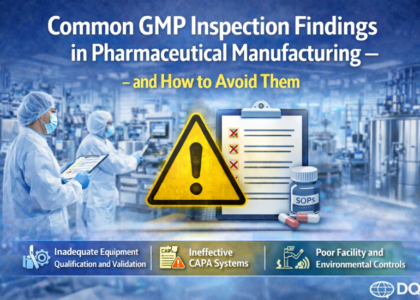
- Validation and qualification gaps: Equipment installed without proper IQ/OQ/PQ, process validation conducted as a one-off exercise rather than as a lifecycle, and cleaning validation built on assumptions rather than data.
- Quality control limitations: Analytical methods not validated to ICH Q2(R2), inadequate stability programmes, weak OOS investigation discipline, and insufficient laboratory data integrity controls.
- Data integrity exposure: Hybrid paper-electronic systems without audit trails, shared user accounts, and uncontrolled spreadsheets used for GMP decisions — all of which attract critical findings under PIC/S PI 041 expectations.
- Personnel and training shortfalls: Generic, untracked, or ineffective training that does not produce the role-specific competencies GMP requires.
- Contamination control weaknesses: Environmental monitoring programmes that lack a contamination control strategy, gowning and behaviour programmes that drift over time, and limited microbial trend analysis.
- Supplier and material qualification gaps: Incoming materials accepted without robust qualification, suppliers audited inconsistently, and traceability records that cannot withstand inspection scrutiny.
Each of these challenges is solvable. None of them is solved by paperwork alone. They require structured assessment, targeted investment, and disciplined implementation — which is precisely what UDQS’s consulting services are designed to deliver.
8. UDQS GMP Certification Consulting Services
Ultra Dynamic Quality Systems (UDQS) provides end-to-end GMP certification consulting for pharmaceutical, biopharmaceutical, vaccine, herbal medicine, medical device, food, and cosmetic manufacturers in Kenya and across the region. Our services are structured to match each client’s stage of maturity — from greenfield facility design to certificate renewal — and are delivered by experienced consultants with hands-on GMP, engineering, and regulatory experience.
8.1 GMP Gap Assessment
Every engagement begins with an honest, evidence-based diagnostic. UDQS conducts a structured GMP gap assessment against PPB Kenya GMP Guidelines, WHO GMP, EU GMP, US FDA cGMP, or other applicable standards — covering premises, equipment, utilities, personnel, documentation, production, QC, complaints and recalls, contract activities, and self-inspection. The output is a prioritised gap register classified by criticality, with a realistic remediation roadmap, indicative effort and cost ranges, and a target inspection readiness date.
8.2 Quality System Design and Documentation
UDQS designs and develops the documentation backbone of GMP — quality manuals, Site Master Files, Validation Master Plans, SOPs, work instructions, forms, registers, training matrices, and management review templates. Documentation is written to be lean, traceable, and audit-defensible, and to reflect how the organisation actually operates rather than imposing theoretical structures that staff cannot sustain.
8.3 Facility, Utilities, and Equipment Readiness
Drawing on chemical and process engineering expertise, UDQS supports facility design review, HVAC and clean utilities (Water for Injection, Purified Water, clean steam, compressed gases) specification and qualification, equipment selection, and integrated commissioning and qualification under ASTM E2500. Where existing facilities require upgrades to meet PPB and international expectations, UDQS scopes the works, supports vendor selection, and oversees qualification.
8.4 Validation and Qualification Programmes
UDQS executes the full validation lifecycle — URS, DQ, FAT/SAT, IQ/OQ/PQ for equipment and utilities; three-stage process validation for sterile, non-sterile, API, and biologics processes; cleaning validation with HBEL determination; sterilisation and aseptic process validation; analytical method validation; and computerised system validation under GAMP 5 (2nd Edition). All work is risk-based and aligned with EU GMP Annex 15, ICH Q9(R1), and FDA Process Validation Guidance.
8.5 Quality Control Strengthening
UDQS supports QC laboratory design, instrument qualification, analytical method lifecycle management (ICH Q2(R2)), microbiology and sterility assurance, stability programmes (ICH Q1), OOS/OOT investigations, reference standard management, and ISO/IEC 17025 accreditation where applicable. QC strengthening is critical for both PPB certification and WHO Prequalification readiness.
8.6 GMP Training and Capacity Building
A trained workforce is the foundation of sustainable GMP compliance. UDQS designs and delivers role-based GMP training programmes — from foundational awareness for new hires to advanced modules on aseptic processing, contamination control, deviation investigation, root cause analysis, data integrity, CSV, and risk management. Train-the-trainer programmes leave clients with internal capacity to sustain learning after the consulting engagement ends.
8.7 Mock Inspections and Inspection Readiness
Before the PPB inspector arrives, UDQS conducts a realistic mock inspection — same format, same scrutiny, same intensity. Findings are documented as if from a real inspection, with classifications, suggested CAPA approaches, and rehearsal of typical inspector challenges. Senior staff are coached on inspection engagement, evidence presentation, and response discipline. By the time the real inspection happens, the team has already rehearsed it.
8.8 CAPA Support and Post-Inspection Response
If an inspection has already taken place and observations have been received, UDQS helps clients prepare CAPA responses that are technically sound, time-bound, and inspection-grade. Where critical findings are involved, UDQS supports both immediate containment actions and longer-term systemic remediation, helping clients move from observation to closure efficiently.
8.9 WHO Prequalification Pathway Support
For manufacturers seeking access to international tenders, donor-funded markets, and the broader African market under the African Medicines Agency, UDQS supports the WHO Prequalification (PQ) pathway — from product dossier preparation strategy and site GMP readiness through pre-WHO inspection preparation. PQ readiness builds directly on a strong PPB GMP foundation.
8.10 GDP and Supply Chain Compliance
UDQS extends its services into Good Distribution Practice for warehouses, wholesalers, and logistics operators handling medical products and HPTs in Kenya, supporting compliance with PPB GDP requirements and WHO PQS-aligned cold chain practices.
9. The UDQS Consulting Approach
Our engagements are structured around four disciplined phases:
- Phase 1 — Diagnostic Assessment: GMP gap analysis, document review, and facility walk-through producing a prioritised compliance roadmap.
- Phase 2 — Design and Documentation: Quality system design, SOP development, Site Master File preparation, and validation master planning.
- Phase 3 — Implementation and Training: Validation execution, facility upgrades, role-based training, and embedding of new processes.
- Phase 4 — Inspection Readiness and Certification: Mock inspection, CAPA support, real inspection support, and certificate maintenance planning.
Throughout each phase, UDQS favours risk-based prioritisation, short feedback loops, working sessions over lectures, and visible deliverables that clients can use immediately. We do not produce documents that sit on shelves; we produce systems that work.
10. Why Choose UDQS
- Local presence with international standards: Based in Kenya, fluent in PPB requirements, working to WHO, EU GMP, US FDA, PIC/S, and ICH expectations.
- Engineering depth: Led by a Chemical and Process Engineer with two decades of regulated-manufacturing experience, ensuring compliance solutions that also work technically.
- Cross-sector breadth: Pharma, biopharma, vaccines, herbal medicines, medical devices, food, cosmetics, and laboratories — with a single integrated quality philosophy.
- Capacity building, not dependency: We transfer skills to your team so that compliance is sustained long after our engagement ends.
- Pragmatic, evidence-based: Deliverables that work for the inspector and for the production supervisor. No theory without practice; no practice without discipline.
- Regional reach: Active across East Africa, the Horn of Africa, and the broader African pharmaceutical and vaccine manufacturing ecosystem.
11. Industries We Serve
- Pharmaceutical manufacturers — sterile, non-sterile, and API.
- Biopharmaceutical and biotechnology companies.
- Vaccine manufacturers, including mRNA, recombinant, and conventional platforms.
- Contract Development and Manufacturing Organisations (CDMOs).
- Herbal medicine manufacturers.
- Medical device manufacturers and in-vitro diagnostics.
- Medical gas manufacturers.
- Veterinary pharmaceutical manufacturers.
- Cosmetic and personal care manufacturers.
- Food and nutraceutical manufacturers.
- Quality control, calibration, and testing laboratories.
- Wholesalers, distributors, and cold chain operators.
- National Regulatory Authorities, Standards Bureaus, and capacity-building programmes.
12. Conclusion
GMP certification in Kenya is no longer simply a regulatory checkbox. It is a strategic enabler — unlocking domestic market access, public sector procurement, regional export, donor-funded tenders, and eventual WHO Prequalification. As the African Medicines Agency matures and Kenya’s local manufacturing ecosystem expands, the manufacturers who invest seriously in GMP today will be the ones supplying the continent tomorrow.
Ultra Dynamic Quality Systems partners with Kenyan and regional manufacturers to make that investment count. From first gap assessment to PPB certificate in hand — and from PPB certificate to WHO Prequalification — our work is grounded in a single principle: quality and compliance are outcomes of capable people working within capable systems. We build both.
Engage UDQS
For a confidential discussion about GMP certification, validation, quality control, GMP training, or inspection readiness for your facility in Kenya or the region, contact Ultra Dynamic Quality Systems (UDQS). We offer initial GMP gap assessments, structured certification roadmaps, and full implementation support tailored to your sector, scale, and target markets.
About the Publisher
Ultra Dynamic Quality Systems (UDQS) provides specialist GMP, quality assurance, quality control, and validation advisory services to pharmaceutical, biopharmaceutical, vaccine, herbal medicine, medical device, food, and cosmetic manufacturers, as well as to regulators, laboratories, and capacity-building programmes across Kenya and the wider African region. UDQS supports clients through GMP gap assessments, PQS implementation, ISO standards implementation, validation and qualification, QC laboratory strengthening, GMP training and capacity building, mock inspections, and regulatory inspection readiness programmes aligned with PPB Kenya, WHO, EU GMP, US FDA, PIC/S, and ICH expectations.