

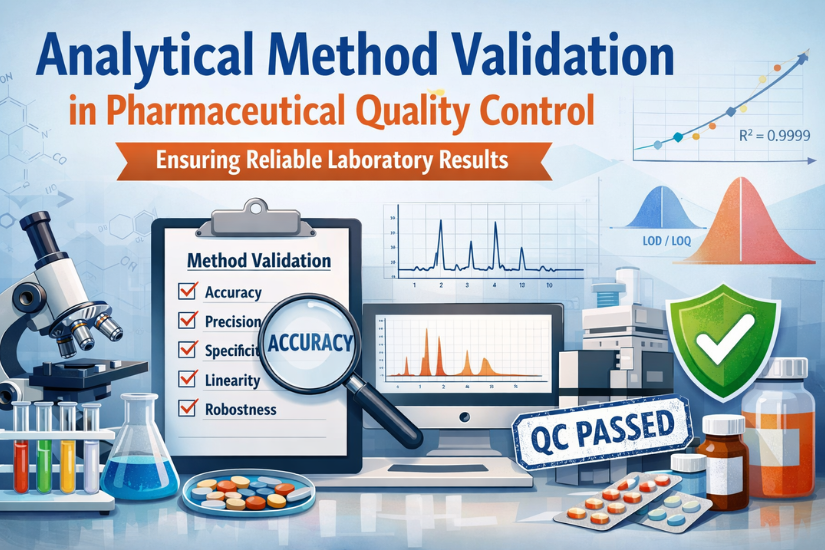
Quality control laboratories play a vital role in pharmaceutical manufacturing by verifying that raw materials, intermediates, and finished products meet required quality specifications. The reliability of laboratory results depends heavily on the analytical methods used to test pharmaceutical products.
To ensure that laboratory methods generate accurate and consistent results, pharmaceutical companies must perform Analytical Method Validation (AMV). Method validation demonstrates that an analytical procedure is suitable for its intended purpose and capable of producing reliable data.
Ultra Dynamic Quality Systems (UDQS) supports pharmaceutical manufacturers and quality control laboratories across Africa in implementing analytical method validation programs aligned with ICH Q2 guidelines, WHO GMP requirements, and international regulatory standards.
Why Analytical Method Validation Is Important
Analytical testing is used throughout the pharmaceutical product lifecycle, including:
- Raw material testing
- In-process testing
- Finished product release testing
- Stability testing
- Cleaning validation testing
If analytical methods are not properly validated, laboratory results may be unreliable, which can lead to:
- Incorrect product release decisions
- Regulatory non-compliance
- Product quality failures
- Delays in regulatory approvals
Method validation ensures that analytical procedures consistently generate accurate and reproducible results.
Regulatory Guidelines for Analytical Method Validation
Pharmaceutical analytical methods must comply with internationally recognized regulatory guidelines.
The primary guideline governing analytical method validation is ICH Q2 (Validation of Analytical Procedures).
Other regulatory frameworks also reference analytical validation requirements, including:
- WHO GMP guidelines
- European Medicines Agency (EMA) requirements
- United States FDA guidance documents
These guidelines define the parameters that must be evaluated when validating analytical methods.
Key Validation Parameters
Analytical method validation typically evaluates several critical performance characteristics.
Accuracy
Accuracy measures how close a test result is to the true value.
Accuracy studies are typically performed by analyzing samples with known concentrations of the analyte and comparing measured results with expected values.
Precision
Precision evaluates the reproducibility of analytical results when the same sample is analyzed multiple times.
Precision is typically assessed at three levels:
- Repeatability (same analyst, same equipment, short time interval)
- Intermediate precision (different analysts or instruments within the same laboratory)
- Reproducibility (between different laboratories)
High precision indicates that a method produces consistent results.
Specificity
Specificity measures the ability of an analytical method to accurately detect the target analyte without interference from other substances.
These interfering substances may include:
- Impurities
- Degradation products
- Excipients
- Matrix components
A specific analytical method ensures that measured results represent the intended analyte.
Linearity
Linearity evaluates whether the analytical method produces results that are directly proportional to the concentration of the analyte.
Linearity studies typically involve analyzing samples across a range of concentrations and evaluating the relationship between concentration and response.
Detection Limit (LOD)
The Limit of Detection (LOD) represents the lowest concentration of an analyte that can be detected but not necessarily quantified.
This parameter is important for impurity testing and trace contaminant detection.
Quantitation Limit (LOQ)
The Limit of Quantitation (LOQ) represents the lowest concentration of an analyte that can be accurately quantified with acceptable precision and accuracy.
LOQ is particularly important for impurity testing and residual analysis.
Robustness
Robustness evaluates the ability of an analytical method to remain reliable when small variations occur in method parameters.
Examples of variations tested include:
- Changes in temperature
- Changes in mobile phase composition
- Slight variations in instrument settings
Robust methods remain stable under routine laboratory conditions.
Analytical Techniques Used in Pharmaceutical Testing
Quality control laboratories use a wide range of analytical techniques to test pharmaceutical products.
Common techniques include:
- High Performance Liquid Chromatography (HPLC)
- Gas Chromatography (GC)
- UV-Visible Spectroscopy
- Atomic Absorption Spectroscopy (AAS)
- Inductively Coupled Plasma (ICP) techniques
- X-Ray Fluorescence (XRF)
Each analytical technique requires specific validation procedures to demonstrate its suitability.
Method Transfer Between Laboratories
In many pharmaceutical organizations, analytical methods must be transferred between laboratories.
This may occur when:
- Contract laboratories perform testing
- Manufacturing sites expand operations
- New laboratories are established
Method transfer studies confirm that receiving laboratories can reproduce validated analytical methods reliably.
Documentation for Analytical Method Validation
Analytical method validation requires structured documentation to demonstrate compliance with regulatory expectations.
Typical documentation includes:
- Method validation protocols
- Raw laboratory data
- Statistical analysis of validation results
- Final validation reports
This documentation is often reviewed during regulatory inspections.
Common Challenges in Method Validation
Many laboratories face challenges when implementing analytical method validation programs.
Common issues include:
- Inadequate statistical analysis of validation data
- Poor documentation of validation experiments
- Insufficient robustness testing
- Lack of proper method transfer procedures
Addressing these challenges early improves regulatory compliance and laboratory reliability.
The UDQS Approach to Analytical Method Validation
Ultra Dynamic Quality Systems (UDQS) provides expert technical support to pharmaceutical laboratories in developing and validating analytical methods.
Key services include:
- Analytical method validation strategy development
- Method validation protocol preparation
- Statistical analysis of validation results
- Method transfer program support
- Laboratory GMP compliance assessments
By combining regulatory expertise with laboratory experience, UDQS helps organizations ensure that analytical methods generate accurate, reliable, and regulatory-compliant results.
Strengthening Pharmaceutical Quality Control Systems
Reliable analytical testing is essential for ensuring pharmaceutical product quality. Validated analytical methods provide the scientific foundation for product release decisions, regulatory submissions, and quality assurance programs.
Organizations that implement structured analytical method validation programs strengthen their laboratory operations and improve regulatory confidence in their products.
Strengthen Your Laboratory Systems with UDQS
Ultra Dynamic Quality Systems (UDQS) supports pharmaceutical manufacturers and laboratories across Africa in implementing robust analytical method validation programs aligned with international regulatory standards.
Whether developing new analytical methods, validating laboratory procedures, or preparing for regulatory inspections, UDQS provides the expertise needed to ensure accurate laboratory testing and GMP compliance.

